
Glossary of International Shipping Terms for Amazon Sellers, Importers, Exporters, and Ecommerce Traders
Confused by the different international shipping terms? Want to request a quote for shipping from China to Amazon, 3pl warehouse or any country in the world, but you don’t understand the different terms and letters that suppliers and carriers throw at you?
This Glossary of International Shipping Terms will help you get a better understanding.
INCOTERMS – International Commercial Terms
INCOTERMS (International Commercial Terms) are a set of trade term definitions developed by the International Chamber of Commerce (ICC) and recognized internationally.
They’re the language you will need when you’re trading abroad.
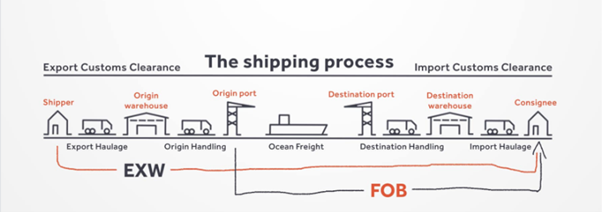
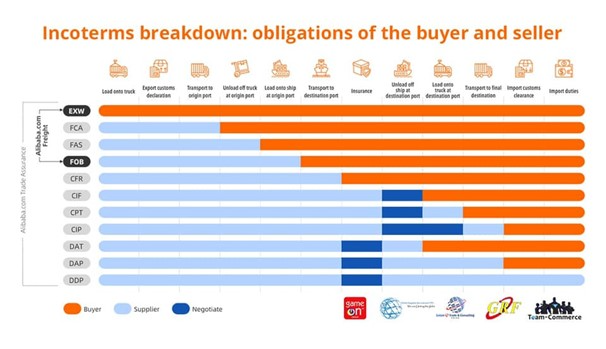
EXW (Ex Works)
The seller \ supplier makes the goods available at his or her premises. The seller also has no obligation to load the goods. In addition, the buyer has limited obligations to provide the seller with proof of export.
The supplier makes the goods available to the buyer when they are packed for export and marked with the required markings.
From this point the full responsibility which includes the insurance, and the burden of payments are transferred to the buyer. All costs and warranty on the goods from this moment on will apply to the customer.
Buyer’s responsibility:
- Collect the goods from the seller’s warehouse and load them.
- Take care of all approvals, including export licenses if necessary.
- Carry all the various fees and tax payments at the export ports.
- To bear all the costs and risks involved in transporting cargo from door to door.
FCA (Free Carrier) –
The seller must ‘deliver the goods to the carrier \ freight forwarder nominated by the buyer at the named place’.
The seller\supplier ends his obligations with the delivery of the goods to the carrier \ freight forwarder nominated by the in the country of export (after carrying out export customs procedures and providing the required documents). Upon delivery of the goods to the international carrier and receipt of a signed confirmation of delivery, the full responsibility passes, both the burden of payments and the insurance from the supplier to the buyer. Customs procedures in the country of export are the responsibility of the customer.
FAS (Free Alongside Ship) –
The supplier terminates his\her obligations after delivering the goods, and carrying out export customs procedures, at the port of the country of export (from which the goods will be loaded onto the ship’s deck). This incoterm is used in sea freight only, usually intended for exceptional cargo and bulk cargo only.
FOB (Free on Board) –
The delivery of the goods, the point at which the payment burden and the insurance pass from the exporter to the importer is with the delivery of the goods on board the ship, at the port of the country of export and includes completion of necessary customs procedures.
This is the point where the responsibility for payments, additional expenses, and the insurance connection from the supplier to the buyer passes.
This condition is for use in sea transport only, but the recommendation is not to use this incoterm for containers transportation.
CFR (Cost and Freight) / CIF (Cost, Insurance and Freight) –
The above two incoterms are recommended for sea freight transactions only.
The insurance in the CFR term of sale, as well as in the CIF, as well as in the terms of sale FOB mentioned earlier, will be the responsibility of the buyer (upon delivery of the goods on board the ship at the port of export).
As for the responsibility for the various payments in the transaction:
Under the CFR terms of sale, the supplier is obliged to enter the contract of carriage with the sea carrier for the form of carriage to the port of the destination country. Under the terms of the CIF the supplier is obligated to terminate the freight contract and purchase the marine insurance policy for the buyer.
CPT (Carriage Paid To) / CIP (Carriage and Insurance Paid To)–
Those two terms of sale mentioned above are terms of sale adapted to international trade transactions carried out in all methods of transportation.
The insurance in these two terms, as well as in the FCA terms of sale, will pass from the supplier to the buyer upon delivery of the goods to the seller’s international carrier\freight forwarder, in the exporting country and the receiving of a signed confirmation of delivery.
As for the burden of payments, under the terms of CPT the supplier is obligated to deliver the goods and pay the cost of the main freight up to an agreed point in the country of import (destination), a point which is before the customs post.
On the other hand, in the terms of CIP the supplier is obliged to deliver the goods, pay the cost of the main freight and the cost of marine insurance up to an agreed point before the customs post in the country of import (destination).
DAT (Delivered at Terminal) –
A transaction signed under the DAT terms of sale means that the seller\supplier\factory must make the delivery at a designated and agreed terminal in the destination country, after unloading, but without the obligation to deal with the import customs. The of customs clearance on import applies to the buyer.
DAP (Delivered at Place) –
In a DAP transaction, the seller\supplier is obliged to deliver the cargo at an agreed place in the importing country, including unloading and without the obligation to handle customs clearance. The goods will be delivered on the same means of transportation that brought it.
Unloading of goods and import customs clearance are the responsibility of the buyer.
The sole obligation of the seller\supplier in the country of import is to transport the goods to the agreed named place.
DDP (Delivered Duty Paid) –
This applies to any mode of transport. The seller must deliver the goods to the buyer, cleared for import, and not unloaded at the named place of destination.
The obligation to unload the cargo at its destination will apply to the buyer.
DDU (Delivered Duty Unpaid) –
Terms of sale are like the DDP we explained above, except for customs clearance and taxes in the destination country.
According to DDU, the seller\supplier must deliver the goods to the destination point, after clearing it from the import customs. However, he is not required to pay customs duties. It is the buyer’s responsibility.
* Price in an international trade transaction will always include the price, the relevant terms of sale, named place, and the INCOTERMS according to which the transaction was made.
Want to learn more about how to choose the right terms of sale for you? Get ideas for smart packaging to reduce costs? Read our article on “5 Effective Ways to Reduce Manufacturing Costs”.
Shipment Modes
The international shipping modes we have are sea, air, and land. When the goods reach the destination country, it passes through a seaport or airport, and on the ground, it continues to be transported using containers, various transport vehicles and railway tracks.
Sea freight can take several weeks and is suitable for large containers, and Air freight is faster and more expensive.
All items must obtain customs clearance and pass-through airport, seaport or land port, in transit between countries.
* There is also Express Delivery – sea express and air express.
Calculation of Weights and Volumes
CBM (Cubic Meters)
The calculation of volume for sea freight is:
Length X Width X Depth X Number of cartons to send = Result
The result should be multiplied by the number 167 and then you will get the weight of the shipping cost.
With express sea shipment, we are charged by KGs, with normal sea shipment we are charged by the higher amount (volume, or weight) usually, it’s by volume.
Weight calculation for Express Sea Freight
Number of cartons X Height X Length X Width, divided by the number 6000 = The result will be the charge weight.
* These details can be the difference of hundreds of dollars, so remember to note this when you are in the stage of developing your product and its packaging. The difference of 1 -2 CM can change the volumes, the charge, and consequently the shipping price.
Standard air freight calculation
Number of cartons X Height X Length X Width, divide by the number 6000 = The result will be the charge weight.
Express Air Freight Calculation
Number of cartons X Height X Length X Width, divide by the number 5000 = The result will be the charge weight.
*Pay attention! When you get the dimensions of the cartons from the supplier or factory, there is always a deviation of up to 2 cm. Why? Cartons are elastic, they are not blocks and when packing, sometimes the sides expand and thus create a higher volume. Every cm is important because if you have 1000 kg to ship, another 1 or 2 cm in volume changes your weight by about 100 kg.
Keep this in mind when designing your product’s packaging and trying to estimate your manufacturing costs.
Additional terms in worldwide shipping worth knowing
LCL – Less Than Container Load
FCL – Full Container Load
ETD – Expected or Estimated Time of Departure
ETA – Expected or Estimated Time of Arrival
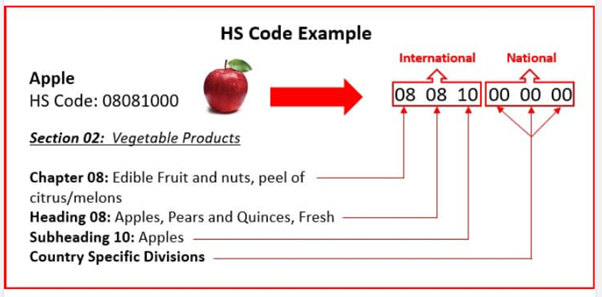
HS CODE (Harmonized System Code) –
Among industry classification systems, Harmonized System (HS) Codes are commonly used throughout the export process for goods. The Harmonized System is a standardized numerical method of classifying traded products.
It is essential that your freight forwarder\carrier use the correct HS code so that you won’t get troubles with customs and pay serious fines.
If you are already working with us and even if you don’t, and you have further questions on international shipping, we will be happy to advise and guide you.
We invite you to try shipping with us, through our company in China which is a large and leading company in the world of logistics, a licensed delegation from 1993, and is part of an international association called World cargo Alliance (the top in international shipping standard).
The company has 7 logistics warehouses throughout China and has contracts with Target USA, Walmart, and Alibaba.
We will accompany you all the way and make sure that your shipping will be done in the best and most professional way. We combine all the advantages of a Chinese shipping company, with export licenses, the experience of over 20 years, and we are proud to say that with many satisfied customers.
To schedule a free consultation call and quote, click here
- 2021 GameOn Group C.L LTD All Rights Reserved
*The content of this article is a collection of daily tips from the leading Facebook group
#Everyday Tip for E-Commerce – Amazon Alibaba eBay and everything in between